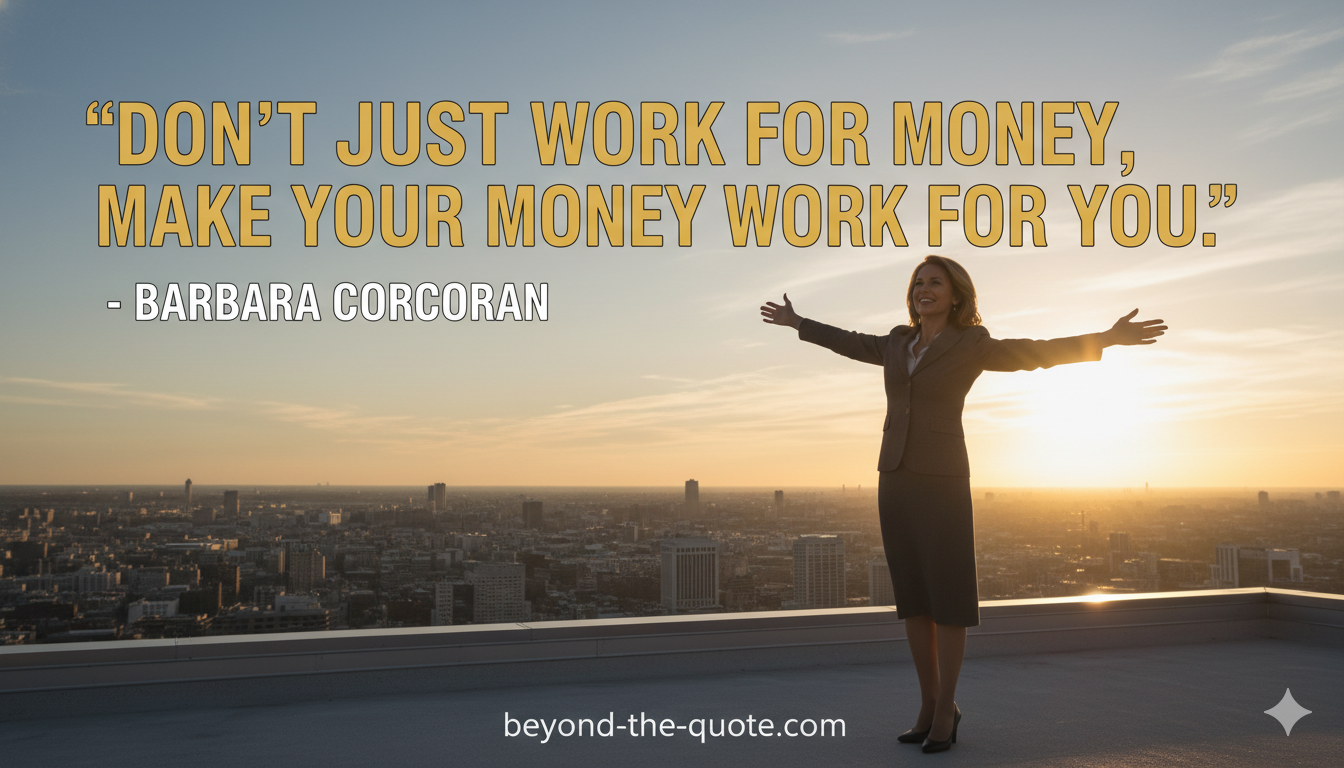
Unlock Your Money’s Potential: Understanding Barbara Corcoran’s Wisdom
Have you ever thought about your money like a little worker bee? Most of us spend most of our waking hours trading our time and energy for dollars. That’s the first part of Barbara Corcoran’s famous quote: “Don’t just work for money.” But what if your money could work for you, even while you’re sleeping, playing, or learning in school? That’s the powerful second half of the message!
Barbara Corcoran, the real estate mogul famous for building The Corcoran Group and her savvy business sense, isn’t just talking about earning a paycheck. She’s talking about financial freedom.
The Basic Idea: Trading Time vs. Making Money Grow
Imagine you have a lemonade stand.
Working for Money: Every glass you sell, you get money. If you stop making lemonade, the money stops coming in. You are trading your time (squeezing lemons, serving customers) directly for money. This is like having a job.
Making Money Work for You: Now, imagine you take some of the money you earned from selling lemonade and buy a second lemonade stand with a friend, or maybe you invest in a machine that squeezes the lemons automatically. Now, that money (the second stand or the machine) is earning you money even if you are busy helping with homework or taking a nap. That’s what Corcoran means.
This concept is called Passive Income or Investing. It means putting your money into things that have the potential to grow or generate more money over time without you having to be actively involved every single minute.
How Does Money “Work” for You? Three Ways to Start Small
Even as a 6th grader, you can start thinking about this! It all starts with understanding that money isn’t just for buying snacks; it can be a tool.
1. Saving and Earning Interest
The simplest way money works for you is through a savings account at a bank. When you put your money in the bank, the bank pays you a tiny bit of money just for letting them hold it. This is called interest. It’s like a thank-you payment from the bank for lending them your money! It might seem small now, but it’s the first step.
2. Investing in Businesses (Stocks and Funds)
When you buy a small piece of a big company (like a company that makes cool video games or sneakers), it’s called buying a stock. If that company does really well, the value of your small piece might go up! Or, they might share some of their profits with you. This is making your money work by owning a tiny part of something successful.
For a great introduction to basic financial concepts and tracking your goals, a fun, engaging book can be a fantastic starting point. Consider something that breaks down big ideas into manageable chunks:
Amazon Affiliate Product 1: The Total Money Makeover: A Proven Plan for Financial Fitness by Dave Ramsey. (This popular book offers a clear, step-by-step system for managing money, which is the foundation for making it work for you later on.)
3. Buying Things That Can Be Rented or Sold Later (Assets)
Think about something like a collectible trading card or perhaps a very well-built LEGO set. If you keep it safe and in good condition, sometimes years later, other people might be willing to pay more for it than you originally did because it’s rare or out of production. This is similar to how real estate works—a house that you own can sometimes be rented out to earn you money every month, or its value can increase so you can sell it for more later.

Why This Matters: Time is Your Biggest Asset
Barbara Corcoran became wealthy because she realized her time was limited. If she only worked for money, she could only earn so much in one day. But if her money started earning more money, the potential income stream was much bigger!
Imagine this:
- Scenario A (Working for Money): You work 10 hours to earn $100.
- Scenario B (Money Working for You): You invest $1,000, and over a year, it earns you $50 in interest without you lifting a finger. That $50 is extra money you didn’t have to trade hours for!
The goal isn’t to stop working entirely (work is important!), but to reach a point where the money you earn from your investments can cover your living expenses. When that happens, you are truly free to choose what you want to do with your time.
Building Your Financial Toolkit
To start building this “money-making machine,” you need the right tools. While you might not be investing large sums yet, understanding how to track your spending and saving is crucial. Having good organizational tools helps you see where your money is going so you can decide where to put it to work.
Amazon Affiliate Product 2: Financial Planner and Budget Notebook for Teens and Young Adults. (A physical journal can be a great way to practice tracking where your allowance or first earnings go, helping you save up for that first small investment.)
The Mindset Shift: From Consumer to Owner
The biggest difference between working for money and making money work for you is a shift in thinking.
- Consumer Mindset: “How much does this cost?” (Focus on spending.)
- Owner/Investor Mindset: “How can this item or investment make me money or save me money in the future?” (Focus on value creation.)
Barbara Corcoran started by buying and selling apartments. She wasn’t just selling houses; she was using her money to buy something that she could turn around and sell for more—she was making the asset (the apartment) work for her!
To better understand the principles of smart asset management and building wealth, reading biographies of successful investors can be very inspiring.
Amazon Affiliate Product 3: The Psychology of Money: Timeless lessons on wealth, greed, and happiness by Morgan Housel. (This book focuses more on the behavioral side of finance, which is key to sticking with any long-term investment plan.)
Conclusion: Start Small, Dream Big
Barbara Corcoran’s quote is a powerful reminder that your earning potential is limited by the hours in a day, but your money’s potential is limited only by your imagination and knowledge. Don’t just settle for trading time for dollars forever. Start learning today about saving, interest, and investing. By making your money work for you, you are not just getting richer; you are buying back your most precious resource: your time.
Affiliate Disclosure: This article contains affiliate links to Amazon. This means that if you click on one of the product links and make a purchase, I may receive a small commission at no extra cost to you. I only recommend products that I believe can genuinely help you on your journey to understanding financial concepts.