Reclaiming Your Power: Unpacking Eleanor Roosevelt’s Most Badass Quote
We have all been there. Maybe it was a passive-aggressive email from a coworker, a backhanded compliment from a frenemy, or a straight-up insult from a random internet troll. Your stomach drops, your face gets hot, and suddenly, you feel about two inches tall.
In that moment of shrinking self-worth, there is one voice from history that you need to summon immediately: Eleanor Roosevelt.
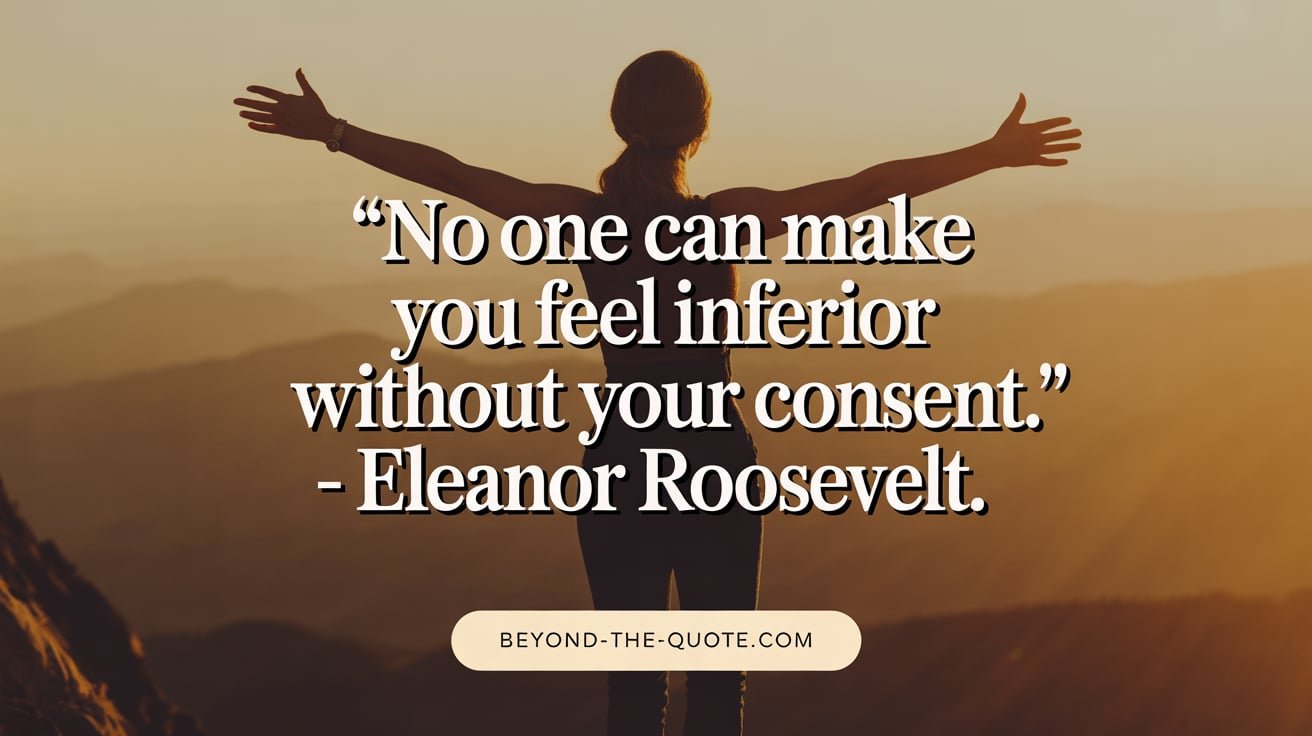
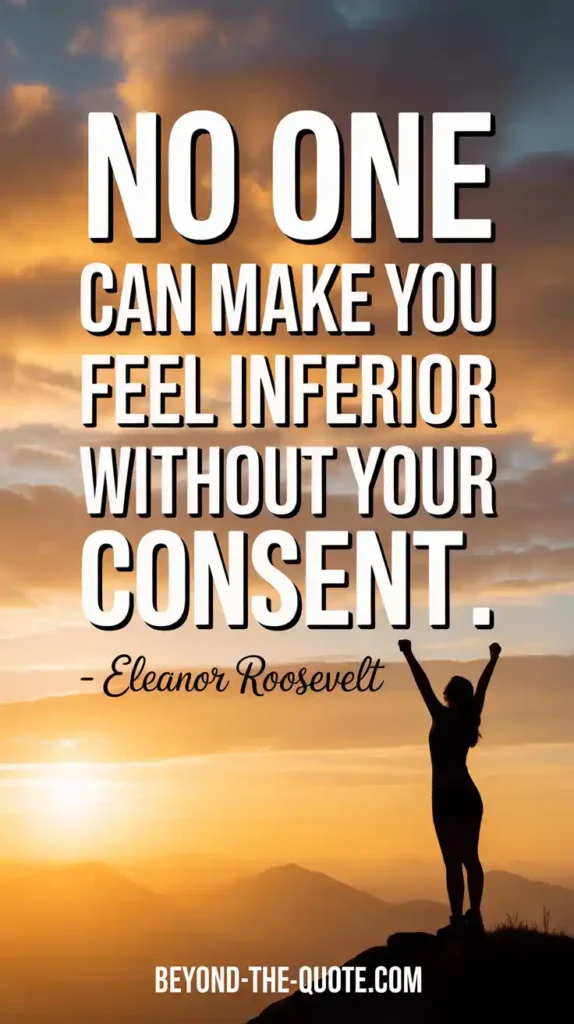
The former First Lady dropped the ultimate microphone on emotional intelligence decades before it was a buzzword when she said: “No one can make you feel inferior without your consent.”
It sounds simple, right? But if we really dig into it, this sentence is a radical guide to emotional survival. Let’s break down exactly what this means, how to apply it without becoming a robot, and why it is the ultimate witty comeback to life’s negativity.
The Anatomy of an Insult
To understand the quote, we have to look at the mechanics of an insult. Usually, we view an insult as an arrow. Someone shoots it at you, it hits you, and you bleed. Cause and effect.
However, Eleanor suggests that an insult isn’t an arrow; it’s a package delivery.
Imagine someone walks up to your front door and tries to hand you a box full of radioactive waste (their criticism, judgment, or nastiness).
- Scenario A: You open the door, sign for the package, bring it inside, unpack it, and let it contaminate your house.
- Scenario B: You look at the box, see it’s leaking green slime, and say, “No thanks, I didn’t order that.” You close the door.
In Scenario B, the person still tried to give it to you. The intent to harm was there. But because you didn’t consent to taking it, the waste stays with them.
Recommended Read: Set Boundaries, Find Peace
Learning to close that door requires strong boundaries. If you struggle with saying “no” to other people’s opinions, you need a guide. “Set Boundaries, Find Peace” by Nedra Glover Tawwab is the ultimate playbook for understanding that your feelings are your property, and you don’t have to let anyone trample on the lawn.
- [Amazon Affiliate Link: “Set Boundaries, Find Peace“]
The Power of the Word “Consent”
The genius of this quote lies in the word consent.
Consent implies a transaction. It implies that you are an active participant in your own feelings. When someone calls you “incompetent,” “ugly,” or “annoying,” those are just words floating in the air. They are sound waves.
For those words to transform into the feeling of inferiority, your brain has to perform a translation. You have to hear the words, agree with them on some level, and decide, “Yes, this person is superior to me, and I am less than them.”
If a toddler walked up to you and called you a “poopy-head,” you wouldn’t feel inferior. You’d probably laugh. Why? Because you don’t value the toddler’s judgment on your character. You don’t consent to the insult because you know it isn’t true. Eleanor is challenging us to treat rude adults with the same energy we treat grumpy toddlers.
Why It Stings (The Truth hurts)
Here is the witty, uncomfortable truth: insults usually only hurt when a part of us suspects they might be true.
If someone screams at you, “You are a purple giraffe!” you won’t go home and cry about it. You know you aren’t a purple giraffe. But if someone says, “You are lazy,” and you feel crushed, it’s often because you are already harboring a fear that you might be lazy.
The “consent” happens when your inner critic high-fives the external bully. To stop feeling inferior, you have to work on your self-talk so that when someone insults you, your internal reaction is, “Well, that’s an interesting opinion,” rather than, “They found me out!”
Recommended Tool: The Five Minute Journal
Retraining your brain to stop agreeing with bullies takes practice. The Five Minute Journal is a simple, effective way to boost your self-esteem daily. By focusing on gratitude and self-affirmation for just a few minutes a day, you build an armor of confidence that makes it much harder to give consent to negativity.
- [Amazon Affiliate Link: “The Five Minute Journal“]
Eleanor Walked the Walk
It is important to remember that Eleanor Roosevelt wasn’t just spitting platitudes from an ivory tower. She was criticized relentlessly during her time as First Lady. People mocked her appearance, her voice, her teeth, and her progressive politics.
If she had consented to feeling inferior every time a newspaper columnist made a mean joke about her, she would have never left her bedroom. Instead, she became a delegate to the United Nations and a champion of human rights. She realized that other people’s opinions of her were their problem, not hers.
How to Revoke Your Consent in Real Life
So, how do we actually do this? Next time someone tries to make you feel small, try these mental shifts:
- Consider the Source: Is this person happy? Are they successful? Usually, people who try to make others feel inferior are miserable. Happy people don’t go around destroying others.
- The “Return to Sender” Policy: Visualize their words bouncing off a glass shield. Tell yourself, “I do not accept this.”
- Separate Fact from Fiction: Take the emotion out of it. If your boss criticizes your report, fix the report. That doesn’t mean you are a failure; it means a document needed editing.
Recommended Read: The Autobiography of Eleanor Roosevelt
Sometimes the best way to learn is to go to the source. The Autobiography of Eleanor Roosevelt is a fascinating look into the life of a woman who mastered the art of self-possession. It is witty, insightful, and historically significant—a perfect read for anyone needing a backbone boost.
- [Amazon Affiliate Link: “The Autobiography of Eleanor Roosevelt“]
Conclusion
Eleanor Roosevelt’s quote is a reminder that you hold the remote control to your own emotions. You cannot control what other people say, tweet, or scream. You cannot control if someone is rude to you in traffic or dismissive at a party.
But you can control whether you sign the permission slip that lets their bad mood dictate your self-worth.
Inferiority is not something that is done to you; it is something you accept. So, the next time someone tries to hand you that box of radioactive waste, remember Eleanor. Smile, keep your hands in your pockets, and refuse to sign for the package.
Affiliate Disclosure:
As an Amazon Associate, I earn from qualifying purchases. This article contains affiliate links. If you click through and make a purchase, I may receive a small commission at no extra cost to you. This helps support the creation of content like this.