“I’m Not Arguing, I’m Just Explaining Why I’m Right”: The Gospel According to You
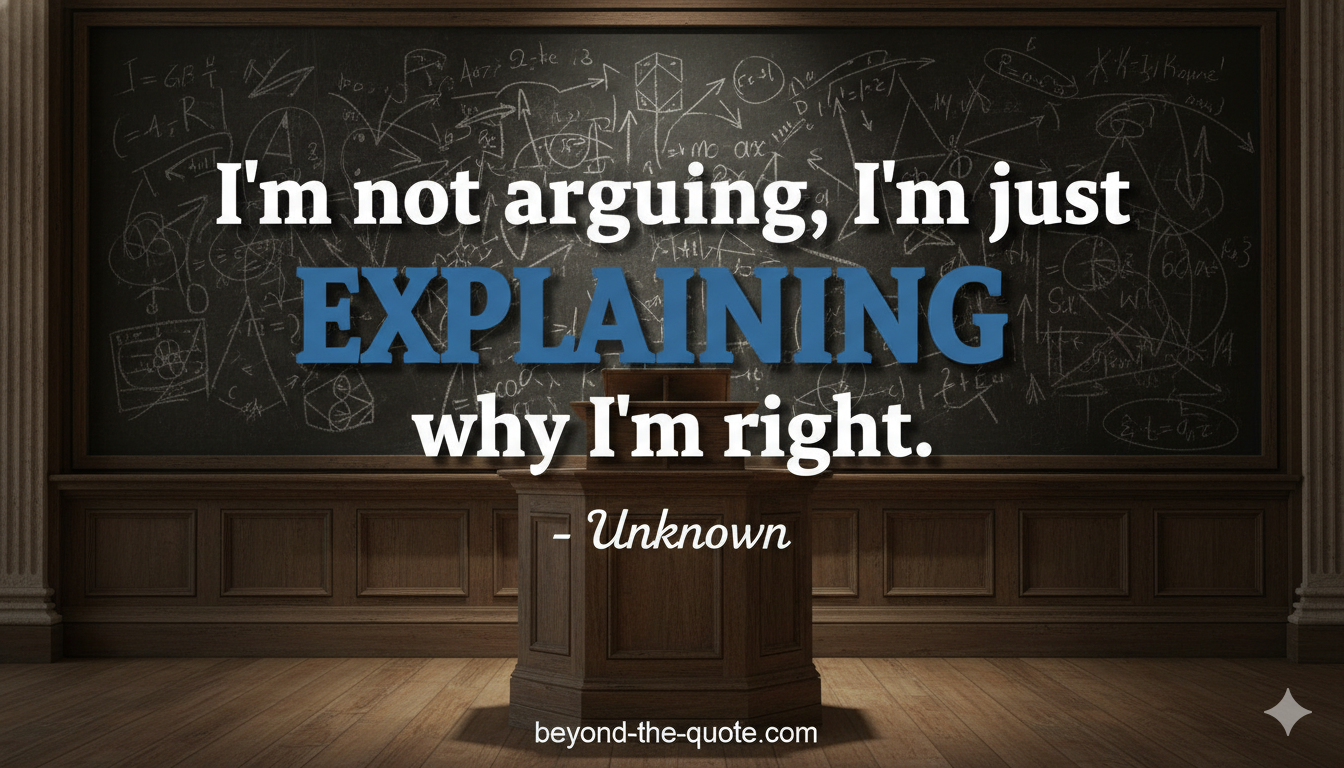
Ah, the immortal quote, “I’m not arguing, I’m just explaining why I’m right.” Attributed to the “Unknown,” which is fitting, because clearly, the person who coined this absolute gem was too busy explaining their undeniable correctness to bother with formal attribution. This phrase is the verbal equivalent of pulling up to a slow-moving tractor on a country road, flashing your high beams, and muttering, “I’m not road-raging, I’m just demonstrating the superior physics of my internal combustion engine.”
The beauty of this statement lies in its supreme, glorious, and completely unearned self-conviction. It’s a linguistic judo move. The moment you utter it, you have instantly transformed the conversation from a messy, unpredictable “argument”—a place where opinions clash and, heaven forbid, compromise might occur—into a structured, one-sided seminar where you are the sole lecturer, and the other party is merely a confused but captive audience.
The Subtle Art of Not Arguing
Let’s be clear: an argument implies two parties with potentially valid, albeit flawed, viewpoints. That sounds exhausting and, frankly, beneath someone of your enlightened status. “Explaining why I’m right,” however? That’s a mission. It’s an act of benevolent pedagogy. You aren’t trying to win; you are simply attempting to correct a temporary, baffling information gap in the listener’s skull.
Imagine the scene: Your friend insists that pineapple absolutely does belong on pizza. In the olden days, you might have entered the messy pit of “but the sweetness clashes with the savory!” or “it gets all soggy!”—a clear descent into the pit of arguing. But now? You pivot. You deploy the phrase. You lean in, adjust your imaginary spectacles, and begin your PowerPoint presentation on the Maillard reaction in conjunction with caramelized sugars, citing historical precedents for fruit pairings in Mediterranean cuisine. You aren’t arguing; you are performing a public service by bringing light to their darkness.
To maximize your explanatory impact, one must be prepared. Having the right tools makes your explanations so much more authoritative. For those moments when your logic needs visual reinforcement (because some people just don’t hear pure reason), a sturdy notebook is essential for sketching out diagrams of your infallible thought process. Consider grabbing this [Amazon Affiliate Product: A High-Quality, Sketch Book]—perfect for detailed flowcharts of why your way is the only way.
Why Logic Requires Volume and Pace
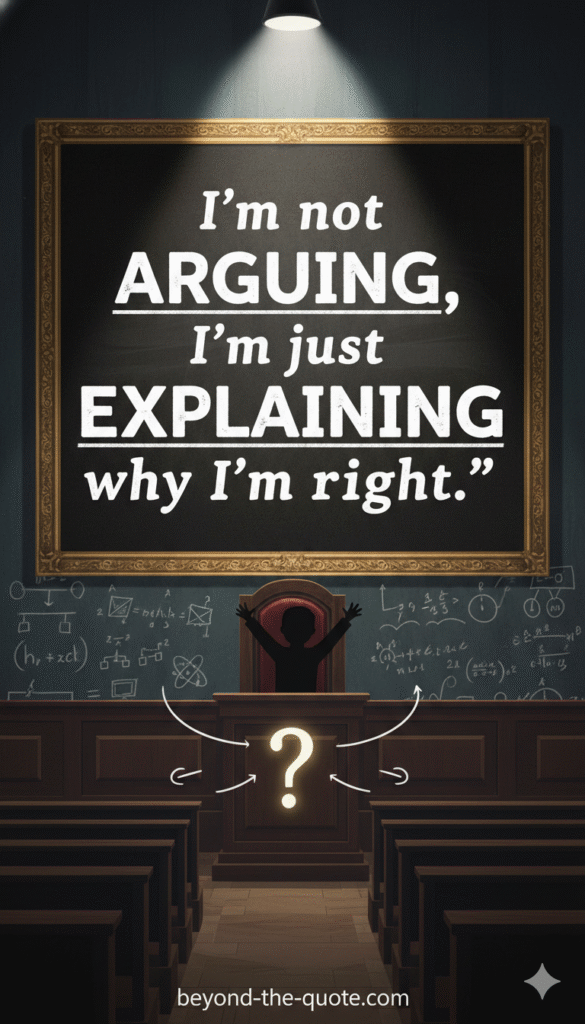
The goal here is not reciprocal understanding; it’s compliance through sheer, unyielding logic—delivered at a pace that doesn’t allow for tedious interruptions like “But what about…?” or “I see your point, but…” That’s why the delivery must be confident. Any hint of hesitation suggests you might actually be open to counterpoints, which, as we know, is just a fancy way of saying, “I’m prepared to argue.” No, no, no. You are explaining.
This technique is especially effective in low-stakes environments, such as determining who finished the last of the artisanal mayonnaise.
Scenario:
Them: “I think you used the last of the truffle mayo.”
You: (Calmly placing both hands on the counter) “I’m not arguing, I’m just explaining why I’m right.” (Pause for dramatic effect) “I distinctly remember using the regular Dijon on my sandwich yesterday, which, as you know, shares a similar hue to truffle mayo in low light. Therefore, based on material evidence and my documented consumption habits, the truffle mayo remains untouched, and you, my friend, have misremembered your midnight snack.”
See? It’s not about being petty; it’s about being precise.
For those moments when you need to maintain a steady, unwavering presence while delivering your irrefutable truths, perhaps a visual aid can help focus the room’s attention on your brilliance. We recommend a [Amazon Affiliate Product: High-Powered LED Desk Lamp]—to ensure the entire room is brightly illuminated for your lecture. After all, it’s hard to see the truth in the shadows!
The Zen of Being Right
Ultimately, the quote is a masterclass in cognitive reframing. It doesn’t deny disagreement; it simply reclassifies it. They think they are disagreeing, but in your reality, they are merely struggling to keep up with the sheer velocity of your correct conclusions. It’s about understanding that some people just need the world presented to them in clear, concise, and correct terms. It’s tough love for the intellectually lagging.
And should anyone dare to interrupt your flawless explanation with something as dull as “Why don’t we just agree to disagree?”, you simply smile serenely, tap your temple, and whisper, “But if we did that, I wouldn’t get to explain why I’m right. And that, my dear soul, would be the real tragedy here.”
To help you document these moments of supreme logical triumph for posterity (and maybe for a future memoir), you’ll need something reliable to record your thoughts immediately after they’ve been validated. Check out this [Amazon Affiliate Product: A Sleek, Voice-Activated Digital Recorder]—because sometimes, your brilliance moves too fast for mere handwriting.
Affiliate Disclosure:
As an Amazon Associate, I earn from qualifying purchases made through the links above. This means if you click on a product link and purchase an item, I may receive a small commission at no extra cost to you. Rest assured, I only recommend products that I believe genuinely support the crucial, high-level intellectual work of always being right.